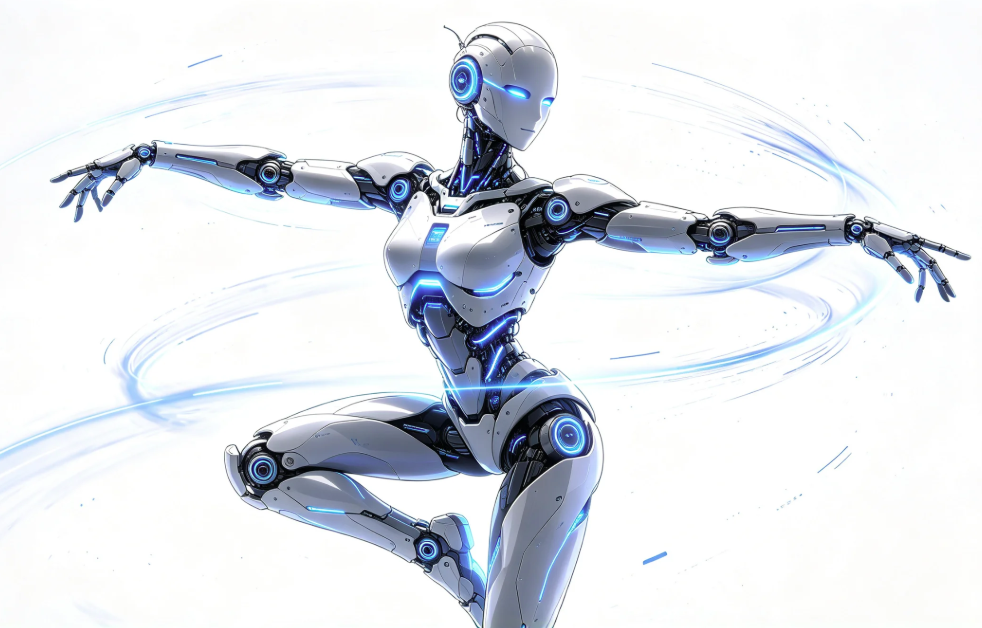
On stage, humanoid robots follow music beats to twist their torsos, swing arms, step and spin. Their movements are coherent and graceful, precisely hitting rhythms, and they can even perform group dances side by side with human dancers. Many audiences marvel at their fluid dance moves, mistakenly assuming the robots merely run pre-written fixed motion scripts and replicate movements mechanically with motors and reducers. In fact, purely pre-programmed motions tend to be stiff and rigid. The robot will fall easily if the ground is slightly uneven or its center of gravity shifts. The seamless and natural dance performance of robots relies on a network of sensors spread all over their bodies. These sensors continuously perceive posture, force conditions and the surrounding environment, and correct motions in real time through millisecond-level closed-loop feedback, just like human beings coordinating muscles across the body to dance with sensory nerves. Sensors serve as the robots’ vestibular balance organs, tactile skin and eyes, the invisible power behind agile dance moves.
Among the full sensor array, the IMU (Inertial Measurement Unit) acts as the core for maintaining dynamic balance during dancing, equivalent to the vestibular system inside human ears that senses balance. An IMU generally integrates a 3-axis accelerometer, a 3-axis gyroscope, and some models are also equipped with magnetometers. It can collect acceleration, angular velocity of rotation and spatial orientation of the robot’s torso simultaneously, with a sampling frequency of hundreds of hertz. In other words, hundreds of sets of posture data are sent to the controller every second. Dancing is completely different from ordinary walking. Dance involves rapid shifts of the center of gravity: standing on one foot, large-scale hip twisting, spinning in place and landing after jumps. The center of gravity shifts instantly, and static balance algorithms cannot cope with such scenarios. When the robot twists its waist and swings its arms, the inertia of the upper body pulls the center of gravity. The IMU immediately captures changes in torso tilt angle and rotation speed, transmits data to the motion control unit. The controller quickly calculates the compensating torque required for hip, knee and ankle joints, and fine-tunes joint angles to counteract the tipping trend caused by inertia. Without real-time feedback from IMUs, robots will lose posture reference during rotation, gradually tilt and fall. Even simple side-to-side swaying requires the IMU to continuously monitor body posture and keep the whole set of motions stable and controllable.
Six-axis force sensors and pressure sensors installed on the soles function as the tactile nerves on the robot’s feet, and are the key to smooth switching of the center of gravity. When humans dance, the soles instinctively sense ground support force and adjust pressure distribution on the feet to smoothly transfer weight from one foot to the other. The sole of a humanoid robot is embedded with six-axis force sensors, which can detect forces in three directions and torques in three directions at the same time. They accurately measure the supporting force, friction and torque exerted by the ground on the sole, and calculate the position of the pressure center. When the robot lifts its foot to dance and stands on a single foot, the sole force sensor feeds back the magnitude of supporting force in real time. The controller adjusts the tilt angle of the ankle accordingly to keep the pressure center within the supporting area of the sole and prevent side tipping. At the moment of landing in a dance, impact force surges instantly. The six-axis force sensor captures the shock load immediately and quickly adjusts the torque of leg motors for buffer and shock absorption, avoiding jitters caused by hard landing. Many people wonder why robots can dance steadily on a stage with slight undulations. It is because the sole force sensors detect tiny height changes of the ground and adaptively adjust leg support, making motion transitions gentle without rigid jerks.
High-precision encoders mounted on every joint are responsible for sensing the position and rotation speed of each joint, ensuring accurate reproduction of limb motion trajectories. Dance movements contain sophisticated limb control: the height of hand raising, swing range of arms and bending angle of knees all have strict requirements. Each driving joint is fitted with a high-precision encoder that measures the current rotation angle and rotation speed of the joint in real time, and constantly compares it with the preset dance trajectory. If the motor is disturbed by load and the actual joint angle deviates from the target angle, the encoder reports the error at once, and the controller adjusts motor output to ensure arms, torso and legs move along the intended path. Thanks to uninterrupted position feedback from encoders, movements such as raising hands and waving arms can be coherent, free of motion lag or dislocation.
Vision sensors and LiDAR undertake environmental perception tasks and play important roles in group dance scenarios. Binocular depth cameras and 3D LiDAR act as the robot’s eyes. They build a 3D model of the stage, identify stage boundaries, human performers and positions of nearby robots, and calculate relative distances in real time. For solo performances, vision sensors help the robot locate itself on the stage and prevent it from stepping out of the performing area while dancing. In multi-robot group dances, vision and LiDAR detect the positions of partners, adjust formation automatically to avoid collisions, and complete neat synchronized group actions. Meanwhile, visual perception can help calibrate posture drift generated by IMUs. During long performances, inertial sensors produce minor accumulated errors, and visual data can correct position and posture information periodically to guarantee stable performance throughout the show.
Flexible tactile sensors are often arranged on the robot’s hands, coming into play when dance performances require holding silk handkerchiefs or props. When humans dance with props, they rely on tactile sensation to grasp force: too much force will damage the prop while insufficient force makes it slip off. Robotic hands equipped with flexible tactile sensors detect pressure distribution on contact surfaces and adjust clamping torque of hands in real time to hold props stably, completing detailed dance moves such as waving and tossing props and making the performance more lifelike.
Nevertheless, smooth dance cannot be achieved by separate operation of various sensors alone. **Multi-sensor data fusion technology** is the key to integrating all perception information. Data collected by IMUs, force sensors, encoders and cameras have their own limitations: IMUs accumulate drift over long working hours, sole force sensors are susceptible to vibration interference, and vision sensors lose accuracy under strong light. The robot controller fuses and computes multi-source sensor information to compensate for defects mutually, establishes a complete state model of the robot itself, and obtains the most reliable data about posture, position and force. It then outputs motor control commands through full-body dynamic control algorithms, forming a complete closed-loop control system. The whole process of perception, computation and command delivery takes only milliseconds. While dancing, the robot keeps sensing, computing and correcting continuously instead of mechanically playing fixed motions. This is the fundamental reason why its movements look smooth.
Many people confuse motion recording with on-site perception. During research and development, engineers capture human dancers’ movements through motion capture equipment and convert human joint trajectories into reference motion trajectories for robots. This only provides a motion template for robots. In real stage performances, minor deformation of the stage floor, performance changes caused by motor heating and air disturbance will interfere with motion execution. The template is merely a reference. Whether the final movements can remain stable and smooth depends entirely on real-time feedback from sensors for dynamic adjustment. Without closed-loop feedback from sensors, robots can only complete motions briefly under ideal conditions. Movements will deform or the robot may fall once slight disturbances occur.
Continuous iteration of sensor technology keeps expanding the expressive power of robot dancing. Early humanoid robots had low sensor sampling rates and insufficient force sensing precision. They could only perform simple stepping with stiff movements and were unable to complete high-dynamic dance moves involving large body movements. With breakthroughs in miniaturized MEMS inertial sensors, small-sized six-axis force sensors and high-speed visual sensing hardware, together with optimization of multi-sensor fusion algorithms and full-body dynamic control, robots can perform challenging dance moves such as spinning, jumping and large-scale limb swings, with motion smoothness getting closer to human beings.
Robot dancing is essentially a concentrated demonstration of bionic perception and motion control technology. Motors and reducers serve as the muscles and bones of robots, while various sensors form the nervous system that helps robots perceive themselves and the outside world. The sensor network captures body posture, ground force and environmental changes in real time. The controller quickly fuses all perception data and dynamically optimizes motion commands for each joint, constantly offsetting external disturbances to achieve stable transfer of the center of gravity and smooth limb movement. In the future, with further improvement in the precision of tactile, force and inertial sensors, as well as continuous optimization of perception fusion algorithms, humanoid robots will be able to perform more dance styles and show more natural and flexible motion capabilities in more scenarios.


