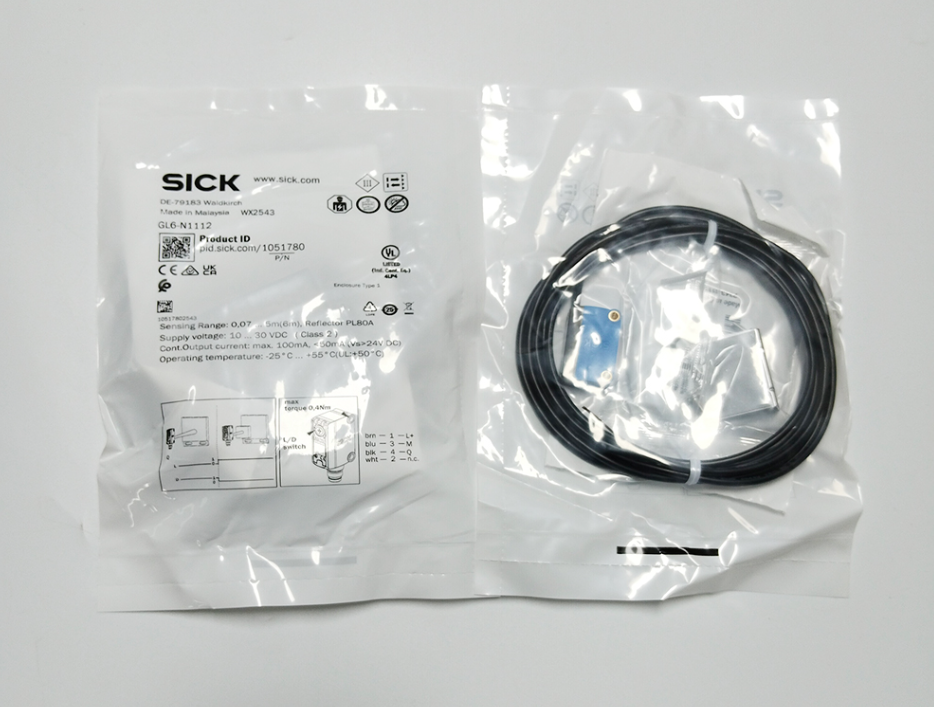
A photoelectric sensor is a non-contact detection device that converts light signals into electrical signals by means of the photoelectric effect. Thanks to its fast response, high precision, and broad material compatibility, it has become the essential “eyes” of machines for achieving precise sensing and intelligent control in the automation era.
Operating Principle: Enabling Machines to “See” the World
A photoelectric sensor typically consists of three parts: a light source, an optical path, and a photosensitive element. The emitter projects a beam of infrared light, visible red light, or laser light. When an object enters the detection zone, the beam is interrupted, reflected, or scattered. The receiver, equipped with photodiodes, phototransistors, or other photosensitive elements, detects the change in light intensity and, through signal-processing circuitry, outputs a switching signal, an analog signal, or a digital signal.
Its underlying physical principle is the photoelectric effect: when photons strike a semiconductor material, electrons absorb energy and change state, producing a measurable current or voltage variation. Because light propagates at approximately 300,000 km/s and no mechanical motion is required, the sensor responds extremely quickly; slotted types can reach microsecond-level response times.
Main Types: Each Suited to Different Applications
By detection method, photoelectric sensors are mainly classified as follows:
Through-beam type: The emitter and receiver are mounted opposite each other. Detection is triggered when an object interrupts the light beam between them. It offers long sensing ranges (up to tens of meters) and strong noise immunity, and is commonly used for conveyor counting, safety light curtains, and automatic doors.
Retro-reflective type: The emitter and receiver are housed in a single unit and work with a dedicated reflector. Detection is triggered when an object blocks the reflected light path. It is easy to install and suitable for medium- to long-distance detection, widely used in logistics conveyors and packaging industries.
Diffuse-reflective type: Also integrated in one housing, but no reflector is required; it detects objects based on light reflected directly from their surfaces. It is the most flexible to install, but the sensing range is significantly affected by object color and surface material, with better performance on light-colored, smooth surfaces.
Slot type: The emitter and receiver are fixed on opposite sides of a U-shaped slot. Detection occurs when an object passes through the slot and interrupts the light path. It offers high precision and fast response, and is often used for paper detection in printers, small-part counting, and other precision applications.
Fiber-optic type: Optical signals are transmitted through optical fibers, allowing extremely small probe heads. They are heat-resistant and immune to electromagnetic interference, making them suitable for confined spaces or harsh environments.
In addition, there are distance-measuring sensors based on triangulation or Time-of-Flight (ToF) principles, and color sensors capable of distinguishing RGB components for specialized applications.
Core Advantages: Why They Are the Foundation of Automation
Non-contact detection: No physical contact with the object, avoiding wear and contamination and extending equipment service life.
Extremely fast response: Light propagation is nearly instantaneous, making these sensors suitable for real-time detection on high-speed production lines.
Broad applicability: They can detect virtually any object that reflects or blocks light, including metals, glass, plastics, and liquids, without being limited by material type.
High precision and resolution: Capable of detecting tiny objects and fine positional deviations, such as terminal pitch and gear assembly height.
Color recognition capability: Because different colors reflect light differently, photoelectric sensors can be used for color-mark detection and sorting.
Wide Applications: Ubiquitous from Factories to Daily Life
Industrial automation: Used on automated production lines for workpiece detection and positioning, counting and speed monitoring, packaging and assembly quality control, and web/film control, forming the sensing foundation of smart manufacturing.
Logistics and warehousing: Applied to parcel dimensioning, barcode recognition, bin-level detection, and inbound/outbound verification, supporting 24/7 high-efficiency sorting.
Automotive manufacturing: Precisely positions workpieces on body welding lines to ensure accurate robot gripping and assembly.
Safety protection: Implemented as safety light grids around presses and cutting machines, for AGV collision avoidance, and for monitoring unauthorized entry into hazardous areas.
Daily life: Found in automatic doors, sensor faucets, robotic vacuum obstacle avoidance, printer paper-jam detection, and smartphone ambient-light sensing, deeply integrated into everyday life.
Medical and environmental monitoring: Pulse oximeters, blood glucose meters, smoke/turbidity detectors, and water-quality monitoring systems also rely on photoelectric sensing technology.
Future Trends: Smaller, Smarter, and More Integrated
Miniaturization and integration: On-chip spectrometers, quantum-dot sensing chips, and photonic integrated circuits (PICs) are embedding sensing capabilities into smaller chips, reducing power consumption and footprint.
New-material drive: Organic semiconductors, perovskites, and quantum dots are enabling flexible and stretchable sensors, paving the way for wearable medical devices and electronic skin.
Intelligence and solid-state design: ToF-based and solid-state LiDAR sensors, which have no moving mechanical parts, are accelerating adoption in consumer electronics and industrial applications; AI-driven intelligent detection modules can automatically adjust parameters according to the scenario.
Single-photon detection breakthroughs: Devices such as Single-Photon Avalanche Diodes (SPADs) achieve photon-level sensitivity, advancing next-generation LiDAR and 3D imaging technologies.
From factory production lines to smart homes, and from medical equipment to autonomous driving, photoelectric sensors are connecting the entire chain of industrial manufacturing and public services through precise sensing. As materials, processes, and algorithms continue to advance, these “eyes of machines” will see more clearly, farther, and more intelligently, continuing to propel the automation and intelligence era forward.


